


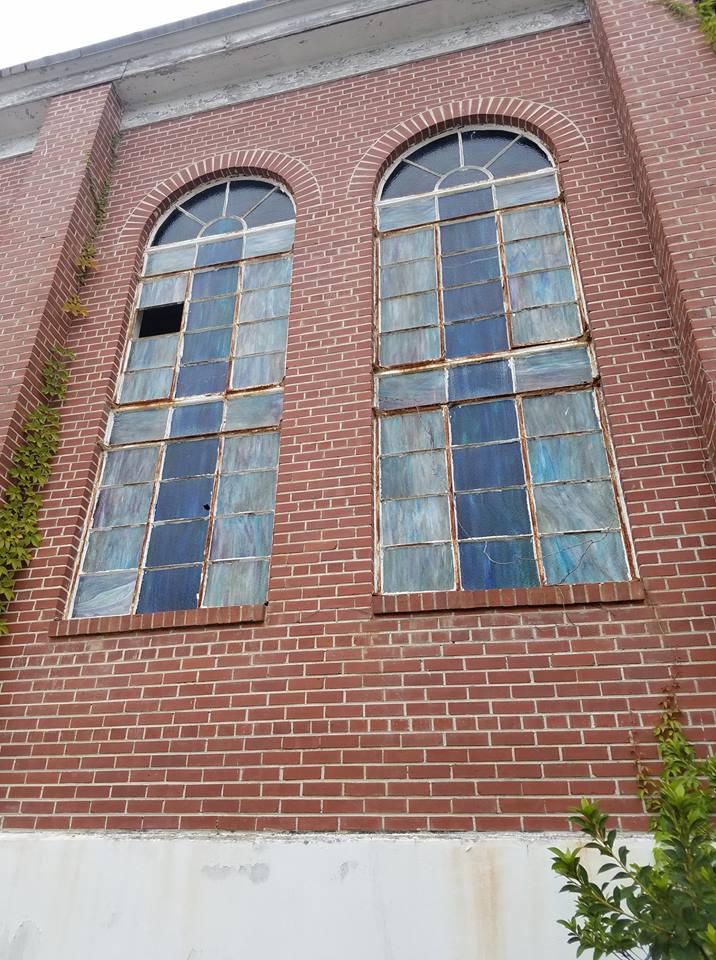


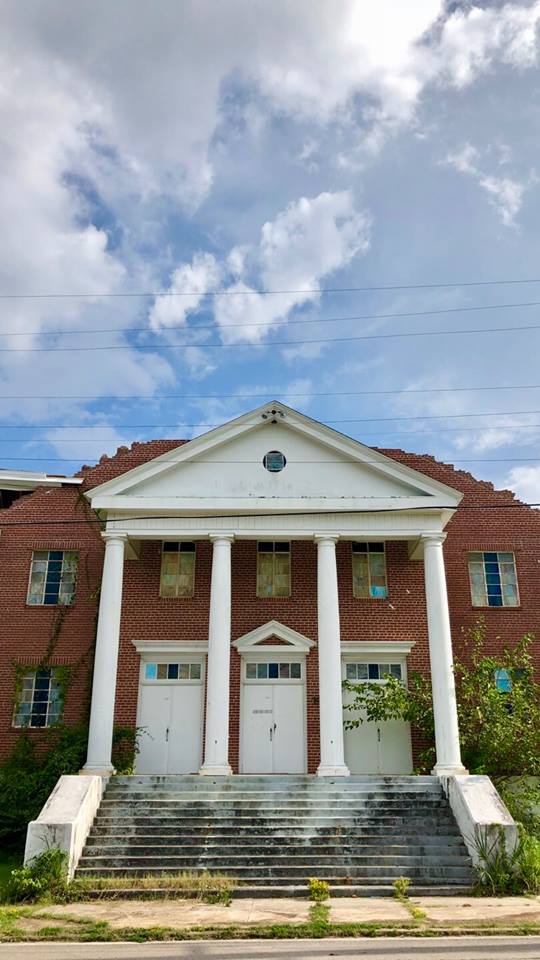


Today the church sits in ruins. — The church where I was baptized.
In 2004 Hurricane Ivan was its last knell, breaking through its stained glass windows, leaving holes in its roof. The holes have grown over time. Only a brick hulk remains today, slowly rotting in the summer downpours of this Gulf Coast city, Pensacola.
Sic transit gloria mundi. Thus passes the glory of the world. — It was a phrase I often heard inside this building. Nothing temporal can be trusted in the great scheme of eternal love because temporal things never last.
Whitfield Memorial was a Southern Baptist church, originally organized as a Baptist mission on West Hill in 1905. It was named after a beloved pastor who served from 1907 until 1910, W.W. Whitfield. The now-abandoned sanctuary building on West Jackson Street was first opened for worship in 1951, just a few years before I was born.
My parents chose Whitfield as a good place to rear children. It was an obvious choice. Church leaders of the 1950s fostered a family-oriented ministry that strongly believed it took a village to raise a child. — And the village was the church teaching Christian principles.
Some of my earliest memories are inside the Whitfield nursery with other children, all of us supervised by the many parents of the church. The nursery was an amazing place to a child in the late 1950s, when television still was new and playful diversions were hard to come by.
Good men in the church who fancied themselves carpenters had fashioned a wooden play kitchen in the nursery full of wooden play utensils. It was all a child needed for amazing games of pretend. The men also had built a large wooden rocker shaped like a boat that could hold a passel of Southern Baptist young’uns, ‘hooping and hollering up a storm while their parents worshiped inside the nearby sanctuary.
And we loved it. We used that rocking boat every Sunday to sail on to Timbuktu, or to tour the Grand Sphinx of Egypt, or to wander back in time to the Royal Palace of King Solomon himself. — Riding a magical rocking boat of imagination.
I cannot remember a happier time. — Singing simple songs like “Jesus loves me, this I know, for the Bible tells me so.” — Memorizing short Bible verses, “God loved us and sent his Son.” — Singing “What a Friend We Have in Jesus” in the Youth Choir, where much of our social life began. — Practicing Sword Drill, where we children stood in front of the adults and, on command, quickly located verses about God’s love in our Bibles.
It escapes me, the exact year when the mood changed. — Sometime in the early 1970s. — But attitudes definitely darkened. What had been a warm message of love became, by increments, rigid and fearful of what was happening in the larger world. Dissent that once was tolerated now was slammed down hard.
One Sunday I made the mistake of suggesting in Bible class that evolution was simply a tool God Himself had fashioned for the Creation. — I was called out by one of the church leaders and told to recant. That reprimand was the first time I remember my church placing itself in opposition to learning.
As I moved into adolescence, the gap widened between what I understood of learning and what the church insisted was Biblical. More than that, the church also began to react to social events happening in the neighborhood that surrounded it.
Whitfield Memorial was built in what was a white working-class neighborhood in 1905 — one only blocks away from the African-American community known in Pensacola as Belmont-DeVilliers. By the 1970s, whites were fleeing to the suburbs. And that meant that black families were moving into the city blocks nearest to the church.
One Sunday a black family showed up for the worship service. To his credit, our pastor let them sit in the church’s seats without any hint there was a problem. But members of the church were unhappy, and some got up and left before the sermon about God’s love could begin.
It was in that same period of time that Whitfield Memorial started a small mission church outside the city, in the suburbs, where its members were building their new homes.
After a few years, that suburban church under a new name had captured almost all of the members of Whitfield Memorial. There was no abrupt break, and a few of the old families refused to abandon the 1950s building on Jackson Street. But by then, Whitfield’s tithes had dropped to nearly nothing.
The old church struggled onward in time but never seemed able to draw new members from the changing neighborhood that surrounded it. When Hurricane Ivan hit in 2004, the church was uninsured. So it was unable to afford the extensive repairs the storm made necessary.
Now it lies derelict, a testament to the glory of the world and the world’s view of love.
Postscript: A few weeks after this post was written, the church was completely demolished. The last four photos show the demolition.
 Robert Craig Waters